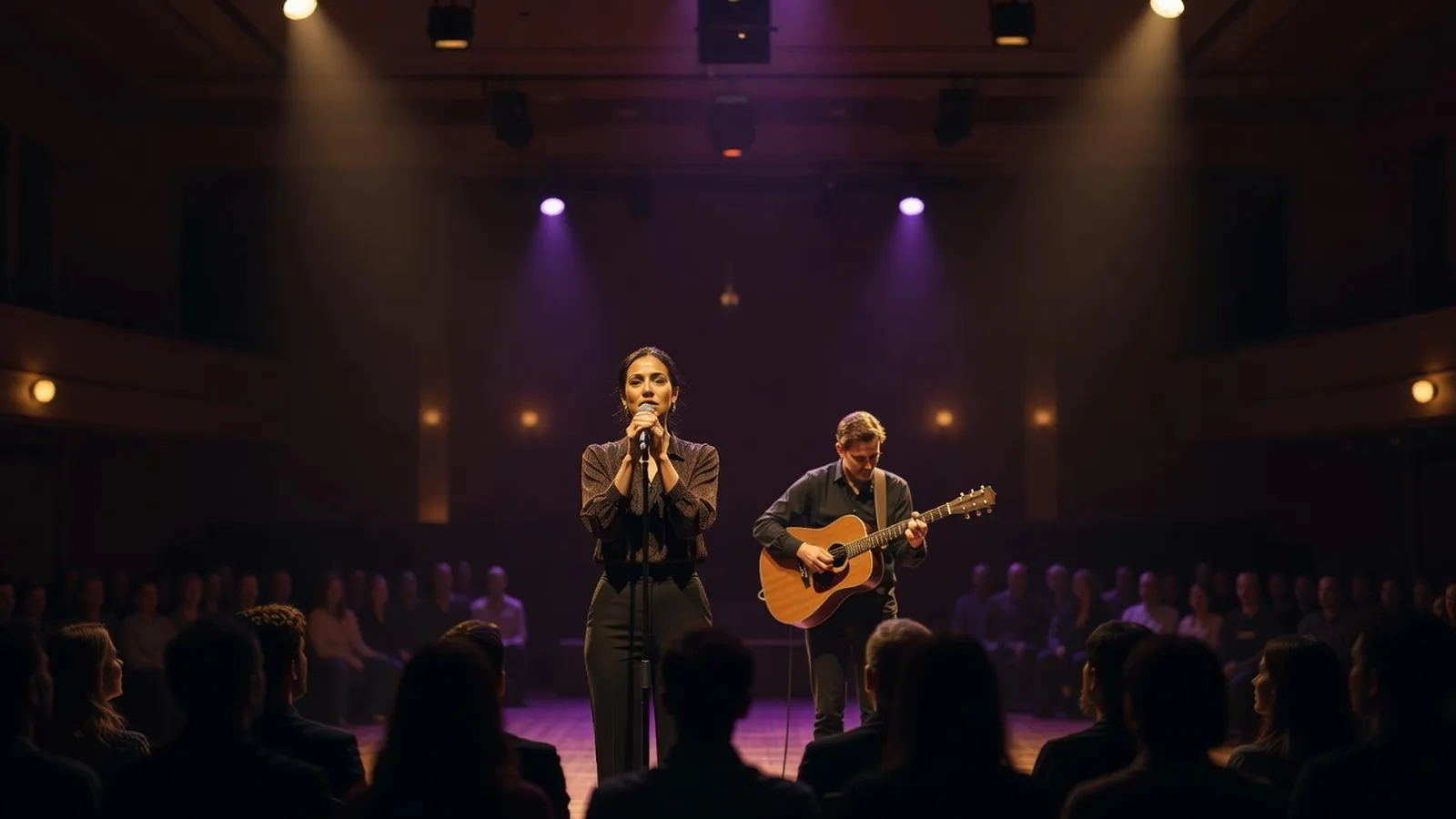
If you want to watch players cue each other, start with the back-room shows at the Horseshoe Tavern; for rock, look at Lee's Palace. Compare the Danforth Music Hall when you want a hall-scale performance, and Scotiabank Arena when the whole stage picture is part of the appeal. Choose the show as carefully as the building: the view, the sound, the age policy and the route to a comfortable spot matter more than a capacity figure.
Verified on November 27, 2026.
A room-size guide, not a capacity ranking
Think of a concert you enjoyed. What do you remember seeing? It might be a drummer looking up just before the band came back in, or a stage going dark while an audience kept singing. Those memories suggest rather different nights out. Room size is useful as a first filter because it makes you think about the distance you want between yourself and the music. It won't tell you where in a particular room you should be.
| Scale to explore | Toronto starting point | What might draw you there | Detail to settle before choosing |
|---|---|---|---|
| Small, back-room show | Horseshoe Tavern | The prospect of watching musicians work at close range | Is there a performance in the rear room on the night you have in mind? |
| Club-scale rock room | Lee's Palace | A rock calendar to browse when the music comes first | Does the particular bill suit what you want to hear? |
| Mid-size hall experience | Danforth Music Hall | A performance with the stage as the focus of the outing | What standing or seated arrangement applies to the show? |
| Large arena production | Scotiabank Arena | A view of the staging and the audience together | Where is the stage in relation to the area you're considering? |
Source: Official venue information from the Horseshoe Tavern, Lee's Palace, the Danforth Music Hall and Scotiabank Arena. The size groupings are editorial comparisons, not attendance limits.
Read down the last column before you read across to a venue name. If sitting matters more than being close, a small room with a promising bill might not be your starting point after all. If you're happy to stand but want to see the exchange between a guitarist and a drummer, you might pass up a grand view of the production for a less distant one. Neither decision requires knowing how many people fit in the building.
Destination Toronto's guide to live music venues includes both Massey Hall and the Horseshoe Tavern. A list like that is useful for finding names to investigate; it isn't a description of what's on when you're free. Our Live music in Toronto guide is a starting point if you're still deciding what kind of outing to put together. Once a particular performance catches your ear, switch from browsing places to reading about that show.
On Queen West and Bloor West, read past the venue name
The Horseshoe Tavern's history dates the Queen West venue to 1947. For someone planning an evening, another detail on its site is just as useful: the front bar opens every day, while live music and other events take place in the room at the back. An open front door answers the question “Can we go to the bar?” It doesn't answer “What are we going to hear?”
That distinction can settle a disagreement before anyone sets out. Perhaps a friend imagines talking over a drink and catching a little music, while you imagine listening from the opening notes to the end of the set. For the latter plan, make the rear-room listing the starting point and agree to do the talking before the music. For the former, don't promise a live set on the strength of the bar's hours. There's room for both ideas in an evening, but they aren't interchangeable.
In the Annex, Lee's Palace is a rock concert venue on the south side of Bloor Street West. The Lee's Palace calendar is a useful place to start with a musical preference rather than a neighbourhood. Look at the whole bill. If you're drawn by a particular act, would you also enjoy listening to the rest? If it's a night of discovery, try listening to a little of the music without looking at the genre description first. You may like the voices and not the pace, or find that an unfamiliar sound is precisely the attraction.
For a small-room outing, be specific about what “close” means. You might enjoy seeing someone's hands on an instrument without wanting to be pressed up near the stage. A friend may want to follow the singing but dislike looking past other people's shoulders. Decide what you'd be willing to give up for a clearer sightline: proximity, a place together, perhaps some of the view at the side. If none of those trade-offs works, look for a different arrangement rather than counting on a gap in the crowd.
Use Toronto after dark: a neighbourhood-by-neighbourhood guide to going out if the decision between Queen West and the Annex also depends on where you want to spend the rest of the evening. Keep the neighbourhood part of the plan flexible if the music is the reason for going. It's easier to change where you meet than to make up for the part of a set you particularly wanted to hear.
The concert hall as a middle choice
The Danforth Music Hall lists its location as 147 Danforth Avenue and publishes its shows on its official site. It's a useful hall to consider if you want something between a back-room set and an arena production. Rather than guessing at the atmosphere from the word hall, open the entry for a performance. Read its description for the music first, then look for information about how you'll watch it.

Suppose the appeal is an ensemble rather than an individual player. At close range, you might follow the person directly in front of you all evening. From farther back, you'd like to see who turns towards whom when the rhythm changes. In that case, ask about a view across the stage, not simply how near you can get. If the voice is what matters and you'd prefer to listen sitting down, look for a confirmed seat rather than assuming that a concert hall implies one.
Take a little care with descriptions of style. “Rock” gives you a sensible starting point at Lee's Palace; it doesn't tell you if a particular set is built around quiet verses or sustained volume. Likewise, the name of a hall doesn't tell you if people will want to move to the music. For a group with different tastes, try describing a passage you'd like to hear rather than naming genres in turn. “I want to hear the voices come in together” gives someone else quite a bit to go on when suggesting a show.
The work behind a performance is another way to understand the difference between the building and the evening inside it. Our interview with a stage manager about how a live night in Toronto comes together takes that backstage perspective. As a listener, you don't need a technical plan. You do need to know which details describe this performance and which ones merely describe the room where it's happening.
At arena scale, choose the angle
Scotiabank Arena is at 40 Bay Street. Its official venue overview gives 19,800 as the highest concert capacity, in a configuration with the stage in the round. The qualification matters as much as the number. It's a description of what the arena can accommodate with a central stage, not a head count or a stage plan for the performance you have in mind.
At this scale, start with the outline of the stage on the event layout, if one is provided. With a central stage, being near the action and looking at the front of a performer aren't necessarily the same thing. With a stage at an end, consider what you'll see from the side as well as from straight on. Trace a line from the area you're considering to the part of the stage you care about. If the layout doesn't make that relationship clear, don't rely on a photograph from a different show.
Distance can be a positive choice. For someone interested in the whole production, the space between a performer and the far edge of the stage may be part of what's worth seeing. Another listener may want the small visual clues that help them follow a solo. Ask each other what you'd be sorry to miss. If it's the sight of an audience responding together, an arena is worth considering on its own terms, rather than as a larger substitute for the rock room you usually favour.
For friends attending together, agree on how you'll find each other if you arrive separately or someone steps out. Pick a meeting point everyone can identify from the venue's current information, not just “by the doors.” Make sure it's reachable by the person taking the least direct route. A workable meeting point is one you could find without following a stream of messages while the music is playing.
All-ages admission and the drinking age are different questions
According to the Alcohol and Gaming Commission of Ontario, the legal drinking age in Ontario is 19. There are all-ages shows in Toronto. For a group that includes someone under 19, check the admission policy on the venue's own listing for the event. The presence of a bar doesn't settle the question, and neither does remembering that a different show in the building was all ages.
Read the wording with the person it affects before making a group plan. If the age designation is missing, ask the venue about the specific performance rather than inviting someone along on the assumption that they'll be admitted. Equally, an all-ages designation answers an admission question, not a question about the sound, the content of a performance or how comfortable someone will feel there. Those deserve a separate conversation, particularly for a first live show.
For a celebration, settle that eligibility question before asking everyone to pick a neighbourhood or vote on the music. The planning approach in Bachelorette party in Toronto: plans by group size and budget is also useful for deciding which part of an evening the group wants to share. If the concert is that part, choose one everyone who wants to attend can enter. If catching up is the priority, give the conversation its own time instead of expecting it to happen during the set.
Accessibility starts at the spot where you'll listen
“Is the venue accessible?” is a reasonable opening question, but it leaves a lot for the person answering to interpret. Try working backwards from the performance. Do you need a seat throughout? Space for a mobility device beside a companion? A view that still works when the people ahead stand? Describe the result you need. Then trace the route between that spot, the entrance, a washroom you can use and the exit.
Here are questions to adapt when the event information doesn't settle the matter:
- Which entrance should I use for this show, and is there a step-free route from there to my viewing area?
- Can I stay seated and still see the stage if the audience in front stands?
- Can my companion watch from beside me, and is there anything we need to arrange beforehand?
- Is there a place to rest if standing in line is difficult?
- If I need a break from the sound, where can I go, and can I return to my place?
Give the venue enough context to distinguish between a preference and a condition of attending. “I'd rather sit” may get you a suggestion about where to look for a seat. “I need to sit for the set and can't use steps to get there” calls for an answer about both the spot and the route. If you're helping a friend plan, let them decide which details they want to ask about and how much of the reply to share with the group.
Treat sound as its own consideration, not a side effect of room size. A close view of an acoustic instrument doesn't tell you what it will sound like amplified, and a distant arena view isn't a promise of a quiet evening. Consider bringing hearing protection suited to listening to music. If volume is a deciding factor, ask about the particular setup and where you could move if it feels uncomfortable. Don't build a plan around being able to step outside and come back without checking.
There's a useful distinction between taking a break and leaving for the night. If you need to leave, would you be comfortable making your way out without the group? If not, agree on who will go with you. If you just need a pause, knowing where to meet afterwards saves you from having to explain yourself over the music. These are good questions for a small back room as well as for an arena.
Turn a shortlist into an evening you'd actually enjoy
Imagine choosing between a rock bill in the Annex and a hall performance on the Danforth. You like the music on both listings. Your friend would happily stand for the rock set but wants to know they can rest beforehand; you'd trade proximity for a view you can hold without shifting around. Now you have a useful comparison. Look for answers about waiting and viewing at each show. The more familiar venue isn't necessarily the one that meets both needs that night.
Or suppose it's the difference in scale that interests you. You know what the music sounds like on a recording and want to find out how it feels with a crowd. Start with the arena layout if you want to see that crowd respond. Start with the back-room listing if you'd rather see a cue pass between the players before the audience hears the change. In either case, leave a little of the evening unplanned. You can decide what you thought of the performance afterwards; you shouldn't have to spend it sorting out where everyone can listen.
Frequently asked questions
Where should I start for a small-room show in Toronto?
Look at the rear-room events at the Horseshoe Tavern on Queen West. For rock in the Annex, check the calendar at Lee's Palace. Read the entry for the particular show rather than relying on the venue name.
How do I compare a concert hall with an arena?
Start with the Danforth Music Hall and Scotiabank Arena as examples. Compare the views available for each performance: do you want to follow individual players or take in the staging as a whole?
Does every concert at Scotiabank Arena have the same capacity?
No. The venue gives 19,800 as its highest concert capacity, for a stage in the round. That figure does not describe every concert layout.
Can someone under 19 attend a Toronto concert?
Yes, if the show's admission policy allows it. Ontario's legal drinking age is 19, but there are all-ages performances. Confirm the age wording for the event on the venue's own site.
What should I ask about accessibility and sound?
Describe the viewing position you need, then ask about the route to it, seating, washroom access and somewhere to take a break from the sound. Ask for answers that apply to the particular performance.
The King West Journal editorial team
General information only. It does not replace advice from a lawyer or legal adviser; rules change, so check with the organization cited.
Frequently asked questions
Where should I start for a small-room show in Toronto?
Look at the rear-room events at the Horseshoe Tavern on Queen West. For rock in the Annex, check the calendar at Lee's Palace. Read the entry for the particular show rather than relying on the venue name.
How do I compare a concert hall with an arena?
Start with the Danforth Music Hall and Scotiabank Arena as examples. Compare the views available for each performance: do you want to follow individual players or take in the staging as a whole?
Does every concert at Scotiabank Arena have the same capacity?
No. The venue gives 19,800 as its highest concert capacity, for a stage in the round. That figure does not describe every concert layout.
Can someone under 19 attend a Toronto concert?
Yes, if the show's admission policy allows it. Ontario's legal drinking age is 19, but there are all-ages performances. Confirm the age wording for the event on the venue's own site.
What should I ask about accessibility and sound?
Describe the viewing position you need, then ask about the route to it, seating, washroom access and somewhere to take a break from the sound. Ask for answers that apply to the particular performance.
Sources
Verified on
- Destination Toronto, Toronto live music venues, Destination Toronto, 2026.
- The Horseshoe Tavern, History, The Horseshoe Tavern, 2026.
- The Danforth Music Hall, Visit, The Danforth Music Hall, 2026.
- Lee's Palace, Lee's Palace, Lee's Palace, 2026.
- Scotiabank Arena, About the venue, Scotiabank Arena, 2026.
- Alcohol and Gaming Commission of Ontario, Legal drinking age and photo identification, AGCO, 2026.