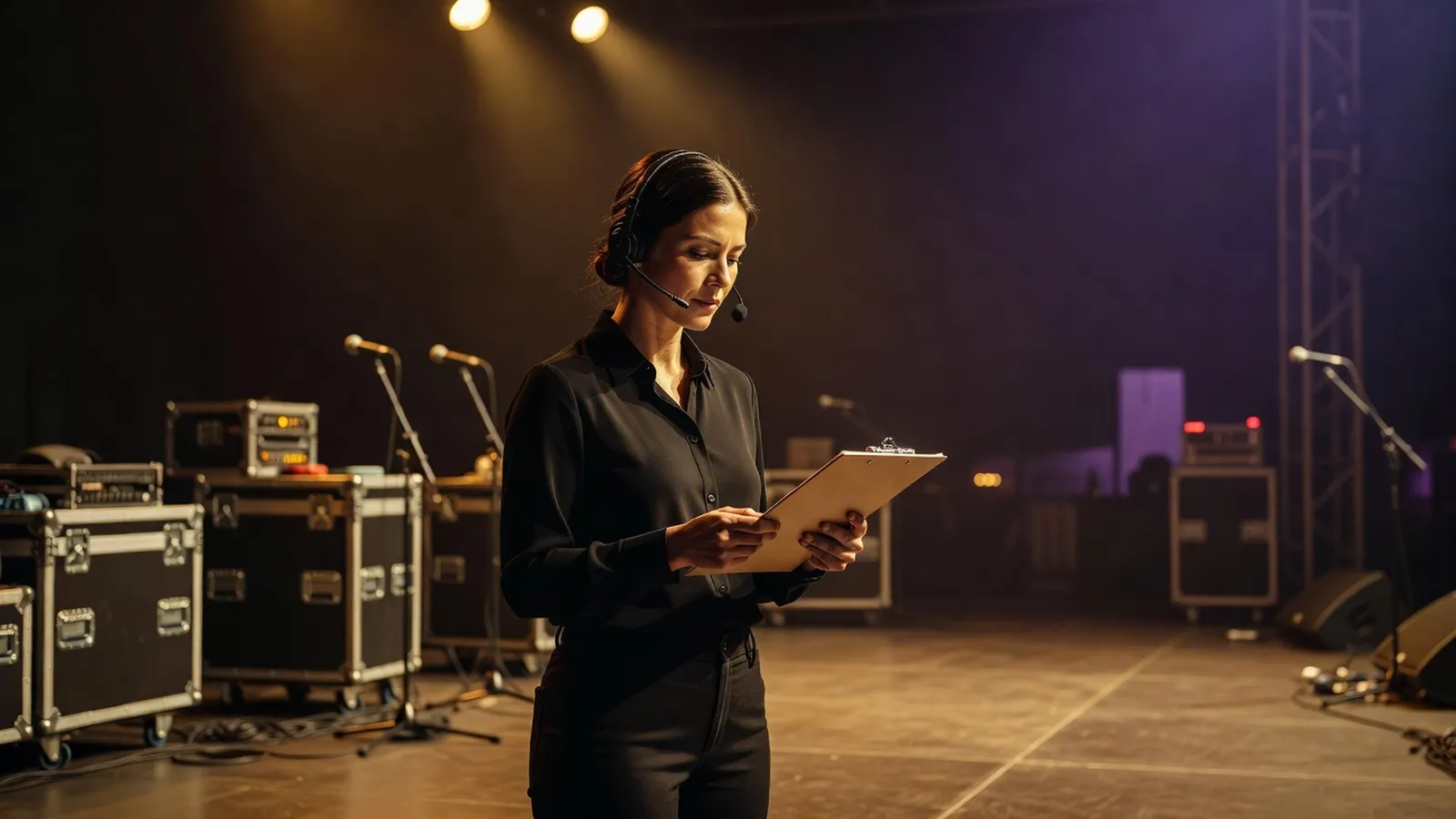

A stage manager
Toronto, expert imagined for this guide
This interview is with an expert imagined for this guide.
A live music night in Toronto starts taking shape before anyone queues outside. Gear needs a clear route to the stage, performers need time to hear themselves, and the crew needs a plan for what moves between sets. We asked a Toronto stage manager, a fictional expert imagined for this guide, to walk through those decisions. The thread running from load-in to doors: keep the people doing the work in the loop, especially when the schedule changes.
Verified on 27 November 2026
Before the gear comes in
What do you want to know before anyone brings a case through the door?
I want to know where the gear is going, not just where it comes in. If you tell a performer to use a side entrance but nobody is there to meet them, you’ve answered only part of the question. Who lets them in? Where can they put a case down without blocking the next person? Can they get to the stage from there, or will they reach a closed door with their hands full?
Then I ask each act to tell me what it’s bringing and what it expects to find. A stage plot is a sketch of where people and gear go. An input list tells the sound operator what needs to be connected. I want both to reflect the show we’re actually doing. If someone adds an instrument after sending the list, I don’t need a polished new drawing. I need to know what the instrument is, where it will go and when we can check it.
I also want a person to go to for each decision. If something changes, the performer shouldn’t have to find out who can help by asking everyone in the room. I tell them who to speak to when they arrive, then make sure that person knows what we’ve promised.
From the editors: Our Live music in Toronto guide looks at the night from the audience side. The City’s music industry support page sets out a different kind of planning: it lists Toronto’s 2022–2026 music industry strategy and its music office.
Getting from the loading door to the stage
What does an orderly load-in look like?
I try to make the first move obvious. If a large piece of equipment needs to cross the stage before the microphone stands go up, I tell the crew what we’re waiting for. Otherwise someone can do a perfectly good job of setting stands and then have to shift every one of them.
When people are arriving close together, I give them clear places to stop. Someone at the entrance should be able to say where a performer can leave a bag, where a case can wait and which things need to go straight to the stage.
Here’s what I’d check on a walk-through before load-in:
- Follow the route from the unloading point all the way to the stage, including any tight turns.
- Point out where unopened cases can wait and where empty cases will go once the gear is out.
- Ask the door lead when the entrance starts being used for guest admission and how gear will move after that.
- Decide who meets a late arrival and where that performer should wait if the stage is already in use.
If someone shows up earlier than expected, I check that there’s room for them to work without sending another person back down the corridor with a case.
What the crew listens for at soundcheck
What needs to happen between plugging in and hearing something the performers can work with?
Start by getting a signal from the right place to the right place. That’s the line check. If the sound operator asks for the keyboard and hears nothing, we can work the problem without the rest of the act playing over it. My job is to make sure the right person is there to play, sing or answer a question, and that nobody takes the quiet moment as permission to start moving gear around them.
Once the signals are coming through, the performers need to hear what they’ll rely on. I ask them to be specific. “I can’t hear the start of the vocal” gives the sound operator something to work with. “It sounds weird up here” might be an honest description, but it takes another conversation to find out what to adjust. I’ll ask an act to pick a passage they know well so they can listen rather than concentrate on getting through unfamiliar material.
A guest musician may be waiting offstage for an entrance, or the act may start with a quiet voice before the rest of the band comes in. Running the opening as planned tells us more than asking everyone to play at once. It also lets me check that the performer who needs the first cue knows where to look for it.
If you’re comparing rooms as a listener, our guide to Toronto live music venues by size and style gives you a way to think about the room separately from the act. A performer checking what they hear onstage is listening for something different from a guest standing out front.

When the running order slips
What do you protect when soundcheck is running late?
I start by asking what’s unfinished. A missing vocal signal and an extra run through a song are not the same problem. If the act can hear what it needs and the opening is clear, we may be able to give up the extra run without losing much. If a performer still can’t hear the cue they enter on, I want to keep working on that.
Then I look for work that can happen away from the stage. Can the next act get its gear ready in the agreed waiting area? Can someone brief the door team while the sound operator finishes? Making up time only helps if the people doing those jobs can get on with them without walking into the soundcheck.
When we revise the plan, I tell people what to do now. “Hold off bringing your gear up; I’ll come and get you” is more useful than “we’re behind.” If a change could affect admission, I let the door lead know while we’re still working it out. That gives them a chance to decide what to tell people who are waiting, rather than learning about a delay from the queue.
The same distinction between a schedule and the instructions people need on the day comes up in our interview on organizing a private party in Toronto. A revised time is only useful if it reaches the people whose work has changed.
Building a changeover that fits the acts
How do you plan the change between sets without turning the stage into a scramble?
I start by separating what stays from what goes. If both acts have agreed to use a stand in the same position, I tell the crew to leave it there. If they’re using their own equipment, I work out where the outgoing piece can go before its replacement comes in. I also ask performers which adjustments they want to make themselves, so a helpful crew member doesn’t undo a set-up the next act was counting on.
Here’s how I might handle different kinds of change on a running sheet:
| What changes between sets | What I’d settle before doors | What I’d confirm before the next cue |
|---|---|---|
| The next act uses gear already onstage | Agree on what stays connected and who can adjust it. | The performer can reach and use what was left in place. |
| The next act brings a different instrument | Set a waiting spot and decide who clears the gear it replaces. | The instrument’s signal reaches the intended input at the sound desk. |
| The next act opens with someone entering from offstage | Agree on where they wait and who gives the cue. | The performer is in position and knows what to listen or look for. |
Source : King West Journal’s illustrative changeover plan, based on the interview.
I’d also plan what happens if we need longer. If someone is introducing the next act, they shouldn’t be sent on just because the previous set has ended. Give them a clear cue. Otherwise the introduction becomes an announcement that the act is about to start when the performer may still be sorting out a cable.
Keeping track of sound after the room opens
If the sound was checked earlier, why does it still need attention during the show?
Soundcheck gives us a starting point. It doesn’t tell us how the performer will sing or play once the set is underway. I ask the act how it wants to flag a problem and make sure the sound operator knows what to watch for. If someone is pointing down, for instance, are they asking for less of something in what they hear onstage, or pointing at a connection that needs attention?
I keep the running order handy because a sound concern may show up around a change we already know about. Is someone moving to another microphone for the next tune? Is a guest about to join? If I know where we are in the set, I can tell the sound operator what’s coming without interrupting the performer. If I’m passing along a concern from a guest, I say where they were standing and what they had trouble hearing.
From the editors: Sound onstage and sound at a point of reception outdoors are separate considerations. The City of Toronto’s noise exemption permit page gives outdoor points of reception amplified-sound limits of 55 dB(A) from 7 a.m. to 11 p.m. and 50 dB(A) from 11 p.m. to 7 a.m. Those limits apply to venues and events including nightclubs, bars, restaurants and concerts. If an exemption is needed, the City says to apply at least 28 days in advance.
Planning for the people coming through the door
What can the stage crew do to make arriving easier for guests?
We can stop treating the guest route as spare working space. If there’s a route the door team plans to direct guests along, I want it marked on the crew’s plan, not just theirs. A case left beside the stage can look out of the way to the person who put it there. Walk towards it from the entrance the way a guest would, and it may be right where someone needs to pass. I try to do that walk with the person who will actually be directing guests.
I also ask what happens if a guest needs to take a different route or asks where to go once inside. The person at the entrance needs an answer they can use, not a message to ask someone backstage. And if we move something during set-up that affects that answer, the door lead needs to know before giving directions.
From the editors: Ontario’s guide to accessible events treats accessibility and inclusion as part of designing an event from the start. Use it when decisions about the entrance, layout and guest information are still open, not just when checking the finished room.
For a privately hired room, our Ontario event space checklist can help prompt that conversation before you sign. Ask who will answer access questions on the night and make sure the answer reaches the people guests will meet first.
Making the call to open
Who says the room is ready, and what happens if the answer is no?
I can say the stage is ready. I can’t say that on behalf of the people taking care of the entrance or the audience area. I want a direct check with the door lead before guests are admitted. If the stage is ready but we’re still carrying gear along a route guests will use, I say exactly that. It tells people more than “we need a bit longer,” and it’s clear what we need to check before we ask again.
It helps to decide in advance what can wait until after doors. I might still need to confirm a cue with a performer in a place away from the audience; that doesn’t necessarily hold up the room. A case that needs to cross the entrance is another matter. Agreeing on the difference beforehand keeps us from having to settle it by talking over each other when people are already lined up.
If we do have to hold, the door team should know who’s coming back with an update. I wouldn’t promise an opening time while the crew is still finding out what’s wrong. I’d tell people what we can confirm and when we’ll speak to them again. When the problem is cleared, I make sure the door lead hears that directly. An open loading door or a burst of sound from inside isn’t a cue to admit guests.
From the editors: For questions about the legal drinking age and photo identification, consult the AGCO’s guidance. For admission details for a particular show, check the organizer’s published information rather than trying to infer the door policy from the running order.
Reading the night from the audience side
What do you wish guests knew about the time printed beside “doors”?
Doors and show start answer different questions. Look for both if you’re making plans around the opening act. If you see only one time, check what it refers to. And if you need to know which entrance to use or what happens if you arrive after the music starts, ask ahead when you can. Those details are more useful than guessing from what happened the last time you went out.
Once you’re inside, a quiet stage doesn’t mean nobody is working. Between acts we may be waiting for someone to confirm that the next performer can hear their cue. The person who knows the answer might be at the sound desk rather than standing under a light. From my side, a good changeover ends with the next act able to start as planned, not with a crew that managed to look busy the whole time.
I’d like guests to feel they know where to go and what’s happening without needing to know who called each cue. That’s the part of the work they should get to enjoy, rather than having to work it out themselves.
Frequently asked questions
What does a stage manager do on a live music night?
The stage manager keeps track of what performers and crew need next, coordinates changes onstage and tells the door lead when the stage is ready. Sound and front-of-house staff confirm readiness in their own areas.
Is soundcheck the same as a line check?
No. A line check confirms that a signal reaches the sound desk through the intended input. A soundcheck also lets performers and the sound operator hear how those signals work together and adjust what people hear onstage and in the room.
Why might doors open later than planned?
An unresolved problem on a guest route, at the entrance or onstage can hold up the opening. Staff should tell people waiting what is happening and when to expect another update, without guessing at an opening time.
Does doors open mean the music starts right away?
No. The doors time is when admission is planned to begin. Look for a separately posted show or set time, and don't assume that a single listed time tells you both.
What makes a changeover easier between acts?
Agree in advance on what stays connected, what moves and who moves it. Identify the next act's first cue and check the inputs it needs before giving the signal to start.
The King West Journal editorial team
Frequently asked questions
What does a stage manager do on a live music night?
The stage manager keeps track of what performers and crew need next, coordinates changes onstage and tells the door lead when the stage is ready. Sound and front-of-house staff confirm readiness in their own areas.
Is soundcheck the same as a line check?
No. A line check confirms that a signal reaches the sound desk through the intended input. A soundcheck also lets performers and the sound operator hear how those signals work together and adjust what people hear onstage and in the room.
Why might doors open later than planned?
An unresolved problem on a guest route, at the entrance or onstage can hold up the opening. Staff should tell people waiting what is happening and when to expect another update, without guessing at an opening time.
Does doors open mean the music starts right away?
No. The doors time is when admission is planned to begin. Look for a separately posted show or set time, and don't assume that a single listed time tells you both.
What makes a changeover easier between acts?
Agree in advance on what stays connected, what moves and who moves it. Identify the next act's first cue and check the inputs it needs before giving the signal to start.
Sources
Verified on
- City of Toronto, Noise exemption permit, City of Toronto, 2026.
- City of Toronto, Music industry support, City of Toronto, 2026.
- Government of Ontario, Guide to accessible events, Government of Ontario, 2026.
- Alcohol and Gaming Commission of Ontario, Legal drinking age and photo identification, AGCO, 2026.
- Government of Ontario, Guide to accessible events, Government of Ontario, 2026.