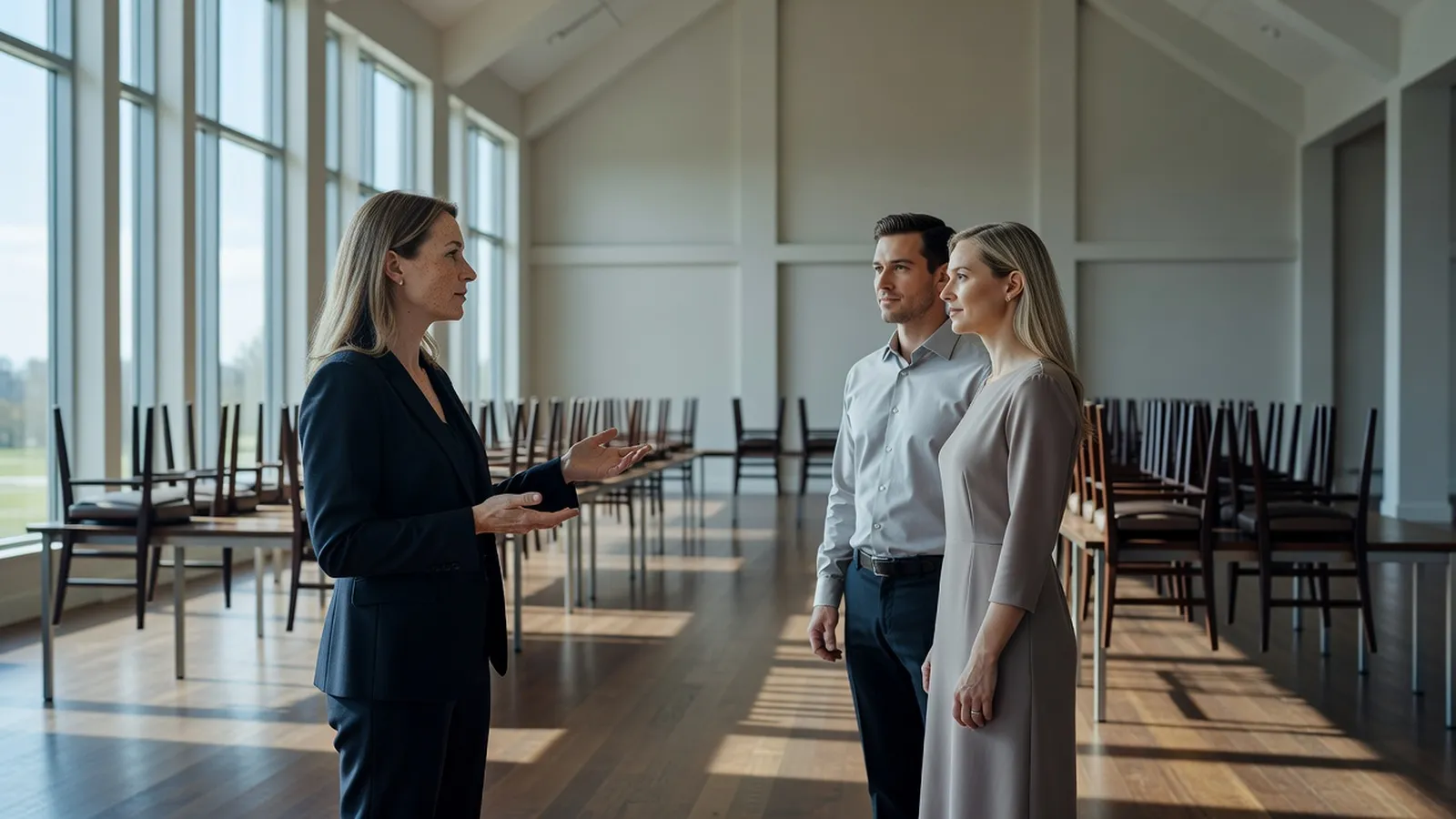
To rent a private event space in Ontario safely, check six things before you sign: who holds the liquor licence (the venue, or you through a Special Occasion Permit applied for at least 10 days ahead), the legal occupant load of the room, the insurance the contract demands, the deposit and cancellation terms, the kitchen and sound system, and accessibility and noise rules. Get each answer in writing, and visit the space first.
A venue rental contract is short, but almost everything that goes wrong at a private event traces back to a line in it that nobody questioned. A caterer who cannot use the kitchen. A guest count the room cannot legally hold. A permit that should have been filed two weeks earlier. This guide walks through the points worth checking, in the order that tends to matter, and keeps to what the official sources say. Where a figure depends on the venue, we say so rather than guess.
Start with the question that changes everything: who holds the liquor licence?
Alcohol is where Ontario's rules are the most specific, so settle it before you fall in love with a room. There are two main situations, and they lead to different paperwork.
The venue already holds a liquor sales licence. According to the AGCO's page on Special Occasion Permits, a place that already holds a licence to sell alcohol generally does not need a Special Occasion Permit for a private event held there. The venue's licence holder stays responsible for compliance with the law. The AGCO page explains who is responsible depending on the situation, so ask the venue to state in the contract who that is, and confirm it with the AGCO before you sign. Do not rely on a verbal "we take care of it."
The space has no licence of its own. A private event with alcohol held somewhere other than a licensed establishment or a private residence calls for a Special Occasion Permit (often shortened to SOP). The AGCO's guide to the permit sets out the conditions that matter for a party planner:
- the event is for invited guests only and is not publicly advertised;
- you are not making a profit on the alcohol;
- the applicant is at least 19 years old;
- the application is submitted at least 10 days before the event;
- the person named on the permit as responsible is present for the entire event.
You can read the conditions directly in the AGCO Special Occasion Permit guide. Notice what that last point means in practice: the person whose name is on the permit cannot leave at ten o'clock to catch a train. If the host group is large, decide in advance who that person is and make sure they know the commitment.
A few practical consequences follow. If you plan a ticketed fundraiser or an event advertised to the public, it no longer fits the description of a private event for invited guests, and you should speak to the AGCO before you sign anything. And if a venue tells you the permit is "easy" or "just a form," remember that the 10-day clock starts when you apply, not when you decide. Building the permit into your timeline from the first day of planning is the simplest fix.
Staffing comes with the permit question too. The AGCO says anyone who sells, serves or delivers alcohol for a licence holder must hold a training certificate approved by the AGCO, such as Smart Serve, which is valid for five years. Ask who is pouring the drinks, and whether they hold that certificate. The details are on the AGCO's page about responsible liquor sale, service and delivery training. The wider context for these rules is in our private events and parties section.
Occupant load: the number on the quote is not always the number the law allows
Venues often quote a "capacity," and it can mean three different things: how many people fit standing, how many can sit at tables, and how many the building is permitted to hold. Only the last one is a legal limit.
The Ontario Fire Code prohibits exceeding the occupant load of a gathering place. The load is worked out from the intended use of the space and the exits available. The Ontario Building Code, Part 3, adds that a floor area with 61 to 600 occupants must have at least two exits. You can browse that part of the code on the Government of Ontario's Building Code Compendium, Part 3.
What that means for you is simple. The legal capacity of a particular room is not something you can work out from a floor plan or by counting chairs. It is something to ask the owner or the City for. Then three habits help:
- Ask for the occupant load of the exact room you are renting, in the layout you plan to use, and ask for it in writing.
- Check whether the stated limit includes staff, performers and a DJ or band, or only guests.
- If you plan a seated dinner followed by dancing, ask whether the occupant load changes when tables are cleared, and who is responsible for managing the door.
A quiet reminder: a room that is technically allowed to hold your group can still feel wrong. Tables, a dance floor, a buffet line and a bar all take space. A walkthrough with your actual layout in mind is worth more than any number on a brochure.

The checklist to carry on your site visit
Photos flatter everything. A visit does not. Take this list with you, print it or keep it on your phone, and tick items off as you see them rather than as you are told about them. Where the answer matters later, ask for it by email so there is a record.
Before you arrive
- I know my rough guest count, including children, vendors and performers.
- I know whether alcohol will be served and whether the event is private and by invitation only.
- I have two or three possible dates, and I know which one I would give up.
- I have asked for a copy of the rental agreement ahead of the visit, not at the moment of signing.
In the room
- The room can be set up in the layout I want: seated, reception, or a mix.
- I have seen the exits and I know where guests will queue for the cloakroom, the washrooms and the bar.
- I have heard the sound system working, not just seen it.
- I have looked at the lighting at the time of day the event will take place.
- I have seen where a band or performer would stand and where they would plug in.
Back of house
- I know whether caterers may use the kitchen, and what the venue expects from them.
- I know where food is delivered, where it is staged and where waste goes.
- I know the access hours for vendors before and after the event.
Access and surroundings
- There is a step-free route from the street to the room, and from the room to the washrooms.
- I have checked how guests would arrive by accessible public transit.
- I have asked what the noise rules are, and until what time music is allowed.
Paperwork
- The licence situation (venue licence or Special Occasion Permit) is stated in the contract.
- The insurance requirement is written out and I have shown it to my insurer.
- The deposit, the payment schedule and the cancellation terms are in writing.
Nothing on this list needs special expertise. It needs patience in the room and a willingness to ask the same question twice.
Questions to ask, and why each one matters
A checklist tells you what to look at. This table tells you what to ask the venue manager, and what the answer protects you from. Keep it open during the call.
| Question to ask | Why it matters |
|---|---|
| Does the venue hold its own liquor sales licence, and who is responsible under it for my event? | Decides whether you need a Special Occasion Permit and who answers to the AGCO if something goes wrong. |
| If no licence, who will be the named responsible person on a Special Occasion Permit, and are they free for the whole event? | The AGCO requires the named person to be present throughout. |
| What is the legal occupant load of this room in my layout, and does it include staff and performers? | The Fire Code prohibits exceeding the load, and the number depends on use and exits. |
| What insurance do you require, and in what form must I show it? | The required amount varies by venue and contract, so there is no standard figure to rely on. |
| What is the deposit, when is it due, and under what conditions is it returned? | Avoids disputes over damage, overtime and cancellations. |
| What happens if I reduce my guest count or cancel? | Cancellation terms are set by contract, not by default rules you can assume. |
| May my own caterer use the kitchen, and what are the rules? | Many problems at events start in the kitchen. |
| What audiovisual equipment is included, and who operates it? | A sound system you cannot use is a sound system you are still paying for. |
| Is the route from the street to the room step-free, and are the washrooms accessible? | Accessibility planning is easiest at the start, and the Province recommends it. |
| Until what time can amplified music play? | Noise rules and neighbours' tolerance set your end time. |
Source: AGCO, Special Occasion Permit guide and Special Occasion Permits; AGCO, responsible liquor sale, service and delivery training; Government of Ontario, Building Code Compendium, Part 3; City of Toronto, Guidance for planning events in Toronto.
Insurance, deposit and cancellation, without the guesswork
These three items are where venue contracts differ the most, and where the official sources are the least specific, for a good reason: there is no standard.
Insurance. The City of Toronto publishes guidance for planning events that covers, among other things, noise, insurance and permits. It notes that the amount of insurance required varies by venue and by contract. So this guide will not give you a number, and you should be cautious of anyone who does without seeing your contract. The useful moves are practical:
- ask the venue to write down exactly what it requires: the type of coverage, whether it names the venue as an additional party, and when proof is due;
- show that wording to an insurance broker or your own insurer before you pay anything, because the cost and availability of event cover can depend on the details;
- ask whether the venue's own coverage applies to your event or whether you must arrange a separate policy for the day;
- if alcohol is served, ask how the venue's requirements treat that.
You can find the City's overview on the City of Toronto event planning guidance page.
The deposit. The amount, the timing and the refund rules are all set by the contract. What you can control is whether you understand them. Ask: Is the deposit a payment toward the rental, a damage deposit, or both? When is it returned, and who decides whether any of it is withheld? Is the balance due before the event or after? Anything unclear should be clarified by email, not by phone.
Cancellation. Think through three scenarios before you sign: you cancel, the venue cancels, and something outside either side's control prevents the event from going ahead. A contract that clearly covers the first and says nothing about the second and third is a contract with a gap. Ask what happens to your money if the venue has to close, double-books, or cannot provide a service it promised. Also ask whether you can reschedule rather than cancel, and what the deadline is.
If you remember only one rule from this section, make it this: every number that is not in the contract does not exist. A promise made on a site visit is worth exactly as much as the paper it is written on.
The catering kitchen and the audiovisual setup: the two things that fall through
Venue descriptions tend to say "full kitchen" and "state-of-the-art sound." Both phrases can hide a lot.
The kitchen. The questions that matter are about who is allowed to use it. Some venues have an exclusive caterer. Others allow outside caterers but set requirements. Some have a kitchen that is really a prep area with no cooking equipment. Ask:
- Is the kitchen available to my own caterer, and are there rules about who may use it?
- What equipment is installed, and what must the caterer bring?
- Where do deliveries arrive, and when can the caterer start setting up?
- Who handles waste and cleaning afterward, and is that covered by the rental?
If a caterer is part of your plan, bring them to the site visit if you can. A caterer will spot a missing prep surface or a long carry from the loading door in thirty seconds. That saves you a conversation later.
The audiovisual system. Describing a room as "equipped" is not the same as it being ready for your programme. Ask to hear it. Ask what is included (microphones, speakers, a screen, a projector, a mixing desk), who sets it up and runs it, and whether you may bring your own equipment or performers. If there will be live music, ask where the band will stand, where the power is, and whether there is any limit on the volume or the hours. If there will be speeches, test a microphone from the back of the room. A system that sounds fine at the front can be unintelligible where your elderly guests are sitting.
This is where private events in a central neighbourhood with several rooms can differ a lot from one another. A format that suits a seated dinner, a reception or a live performance may need different equipment, and a flexible space is only helpful if someone has explained how it is reconfigured. If you are planning a party and want to see how a professional would sequence all of these decisions, our interview with an event planner about organizing a private party in Toronto covers the order in which they tackle them.

Accessibility and noise: your guests and your neighbours
These two are often treated as afterthoughts. They are better treated as selection criteria.
Accessibility. The Government of Ontario explains that the customer service standard under the Accessibility for Ontarians with Disabilities Act (AODA) applies to organizations that provide goods, services or facilities to the public, including banquet halls, once they have at least one employee in Ontario. That is the legal frame. The practical frame comes from the Province's guide to accessible events, which advises planning for accessibility from the start, visiting the venue, providing wide, step-free routes and posting accessible transit routes for guests.
Turning that into questions for the venue:
- Is there a step-free entrance, and is it the main entrance or a separate one?
- Are the routes between the entrance, the main room, the bar and the washrooms wide and free of steps?
- Are there accessible washrooms, and where are they relative to the room?
- Can guests reach the venue by accessible public transit, and can you list the routes on your invitation?
- What would the venue do if a guest needs an adjustment on the day?
You will find more on the legal standard on the Government of Ontario page about how to make customer service accessible. Treat a venue's answer as information, not a guarantee: the best check is still to walk the route yourself.
Noise. The City of Toronto's guidance for planning events lists noise among the topics event organizers should consider. For a private party, the useful questions are local and practical: until what time is amplified music permitted at this address? Are there residential neighbours, and have there been complaints? Is there a person on site who can turn down the volume if asked? Does the contract make you responsible for noise problems, and what are the consequences?
A venue that answers these questions easily has probably been asked them before. A venue that gets vague is telling you something as well.
Reading the contract before you sign it
Once the answers are in hand, the contract should reflect them. Read it slowly, ideally with someone who was not on the site visit. Look for these:
- Names and dates. The correct legal name of the venue operator, your name or your organization's, the date, and the start and end times, including set-up and clear-down.
- The licence clause. Whether alcohol service falls under the venue's licence or under your Special Occasion Permit, and who is responsible.
- The occupant load. Ideally the figure itself, or at least a clause saying the guest count may not exceed what the law allows for the room.
- Insurance, deposit, cancellation. All three, in plain language, with dates.
- Included services. The kitchen, the audiovisual equipment, tables, chairs, staff, cleaning. Anything that was promised and is not listed should be added or struck from your assumptions.
- Exclusions and restrictions. Rules on decorations, candles, outside vendors, noise and end time.
- What happens if things change. Rescheduling, reduced guest counts, closure by the venue.
If something in the contract contradicts what you were told, ask for it to be corrected in writing. If you do not understand a clause, ask. And if the contract is complex, or the stakes are high, speaking to a lawyer before signing is reasonable; this article is not a substitute.
A sensible order of operations
The timeline below is a working order, not a legal requirement. The only date set in the sources we used is the Special Occasion Permit's minimum of 10 days before the event, and that is a floor, not a target.
- Define the event. Private or public, seated or standing, with or without alcohol, rough guest count, rough date.
- Shortlist two or three venues and ask each the licence question first, since it can rule a venue in or out.
- Visit with the checklist, at a similar time of day to your event, ideally with your caterer or another practical person.
- Request the contract and the written answers to the questions in the table above.
- Review insurance with your broker or insurer before you pay a deposit.
- File the Special Occasion Permit application if you need one, well ahead of the 10-day minimum.
- Sign, keep every email, and share the occupant load, the end time and the accessibility details with your guests and vendors.
If your event is a celebration with a themed tone, the same logic applies. For instance, a group planning a night out before a wedding will find the questions about group size and noise in our bachelorette party guide for Toronto a useful companion. And if your guest list includes people travelling from other countries, the wedding side of venue planning is discussed in the interview with a wedding planner about marrying in Ontario with guests from abroad.
Venues in a lively district also come with their own history. If you are curious about how one stretch of King West has changed over the years, read the story of an address in Toronto's King West nightlife. For the wider picture of how private events work in the city, start from our private events and parties section.
Frequently asked questions
Do I need a liquor licence to rent a private venue in Ontario?
It depends on the venue. In a place that already holds a liquor sales licence, a Special Occasion Permit is generally not required, but the AGCO's page makes clear that responsibility depends on the situation, so confirm with the AGCO who is responsible before you sign. In a space with no licence of its own, a private event with alcohol needs a Special Occasion Permit.
How early do I have to apply for a Special Occasion Permit?
The AGCO guide says the application must be submitted at least 10 days before the event. The applicant must be at least 19 years old, the event must be for invited guests only and not advertised publicly, and the person named on the permit as responsible must be present for the whole event.
Who is responsible for the maximum number of guests?
The Ontario Fire Code prohibits exceeding a gathering place's occupant load, and the load is set from the intended use and the exits available. The capacity of a specific room is something to request from the owner or the City, in writing, before you confirm your guest count.
What should I ask about accessibility?
Ask about step-free entrances, wide routes, accessible washrooms and how guests can reach the venue by accessible transit. Ontario's customer service standard under the AODA applies to organizations offering services or facilities to the public, including banquet halls, once they have at least one employee in Ontario. The Province's guide to accessible events recommends planning for accessibility from the start and visiting the venue.
How much insurance and deposit will I need?
There is no single answer. The City of Toronto's event planning guidance notes that the insurance required varies by venue and by contract, and deposits and cancellation terms are set in the rental agreement. Ask for each in writing, show the insurance wording to your insurer, and compare venues on the same terms before you commit.
Verified on 27 November 2026.
General information only. It does not replace advice from a lawyer or legal adviser; rules change, so check with the organization cited.
The King West Journal editorial team
Frequently asked questions
Do I need a liquor licence to rent a private venue in Ontario?
It depends on the venue. In a place that already holds a liquor sales licence, a Special Occasion Permit is generally not required, but you should confirm with the AGCO who is responsible before you sign. In a space with no licence, a private event with alcohol needs a Special Occasion Permit.
How early do I have to apply for a Special Occasion Permit?
The AGCO guide says the application must be submitted at least 10 days before the event. The applicant must be at least 19 years old, and the person named on the permit as responsible must be present for the whole event.
Who is responsible for the maximum number of guests?
The Ontario Fire Code prohibits exceeding a gathering place's occupant load, and the load is set from the intended use and the exits available. The capacity of a specific room is something to request from the owner or the City, in writing, before you confirm your guest count.
What should I ask about accessibility?
Ask about step-free entrances, wide routes, accessible washrooms and how guests can reach the venue by accessible transit. Ontario's customer service standard under the AODA applies to organizations offering services or facilities to the public, including banquet halls, once they have at least one employee in Ontario.
How much insurance and deposit will I need?
There is no single answer. The City of Toronto's event planning guidance notes that the insurance required varies by venue and by contract, and deposits and cancellation terms are set in the rental agreement. Ask for each in writing and compare them before you commit.
Sources
Verified on
- Alcohol and Gaming Commission of Ontario, Special Occasion Permit guide, AGCO, 2026.
- Alcohol and Gaming Commission of Ontario, Special Occasion Permits, AGCO, 2026.
- Alcohol and Gaming Commission of Ontario, Responsible liquor sale, service and delivery training, AGCO, 2026.
- Government of Ontario, How to make customer service accessible, Government of Ontario, 2026.
- Government of Ontario, Guide to accessible events, Government of Ontario, 2026.
- Government of Ontario, Building Code Compendium, Part 3: fire protection, occupant safety and accessibility, Government of Ontario, 2026.
- City of Toronto, Guidance for planning events in Toronto, City of Toronto, 2026.