
A wedding planner
Toronto, expert imagined for this guide
This interview is with an expert imagined for this guide.
Marrying in Ontario with guests from abroad comes down to three questions: who needs a visa or an eTA, how Ontario's marriage rules apply to a ceremony with international guests, and what happens if someone cannot travel. We put them to a wedding planner, a fictional expert imagined for this guide, who describes the order of the work. Our editorial team states the official rules and cites each source.
Verified on 27 November 2026.
Starting the conversation: what comes first
When a couple tells you that half the guest list lives abroad, what do you ask first?
I ask where the guests are travelling from, and then I ask which of them the couple cannot imagine the day without. That second question sorts everything. Some guests are close family whose absence would change the whole wedding. Others are lovely to have but not essential. The answer tells us where to put our energy if travel paperwork becomes complicated.
Then I ask whether anyone has already travelled to Canada recently, because experience with the process calms people down. A cousin who has come before can often talk an aunt through the steps better than I can. I treat the guest list as two layers: people who must be there, and people who would love to be there.
How early should guests from abroad hear about the wedding?
As early as the couple can honestly tell them, even before every detail is settled. A rough season and a city are enough for a first message. People abroad have jobs, school calendars and sometimes paperwork to arrange, and they cannot respond well to a date that arrives with little notice.
I encourage couples to send a short, warm heads-up first and the formal invitation later. The heads-up says: we are marrying in Ontario, this is the approximate time of year, a proper invitation is coming. It lets guests start thinking about leave and about whether they will need travel authorization, without anyone being asked to commit to a booking yet.
Visas, eTAs and invitation letters
Before the next answers, a note from our editorial team on what the official source says. According to Immigration, Refugees and Citizenship Canada (IRCC), visitors to Canada need either a visitor visa or an electronic travel authorization (eTA), depending on their nationality. IRCC's visitor help centre explains how to find out which applies. Approval is never guaranteed, and IRCC may ask for an invitation letter, which also does not guarantee a visa.
So what do you tell guests who ask whether they need a visa?
I tell them I cannot answer that for them, and I say it kindly. The requirement depends on the passport the guest holds, and the rules are written and applied by the immigration authority, not by the couple or by me. What I can do is point them to the official visitor information and suggest they start there rather than relying on a friend's story from three years ago.
I also give guests a plain message: apply early, read the instructions on the official site, and keep copies of everything. Couples sometimes want to take over the process on their guests' behalf, and I gently discourage that. The application belongs to the traveller.
How do you handle invitation letters?
Carefully, and with modest promises. When a guest is asked for an invitation letter, I help the couple write something clear and truthful: who is inviting, what the occasion is, where and roughly when it takes place, and how the guest is connected to the couple. I do not use dramatic language.
The most important thing I say is that the letter does not guarantee anything. IRCC states that it may ask for such a letter and that it does not guarantee a visa. A couple who understands that will not tell a guest "you are definitely coming," and that protects everyone's feelings later.
What if a guest's application is refused?
Then the couple needs a plan that does not depend on that guest. This is why I split the guest list into layers at the start. If someone essential cannot come, we talk about how to include them: a short video message played during the reception, a live link for the ceremony if the couple and the venue are comfortable with it, or a small gathering afterwards when the couple next visits.
I also ask couples to avoid making a guest feel responsible. A refused application is not a failure on the guest's part. I would rather the couple reach out warmly and say, "We will miss you, and we will find a way to celebrate together."

Ontario's rules apply to everyone in the room
Do the marriage requirements change because guests are coming from abroad?
They do not, and that surprises some couples. The marriage itself is governed by the province, and it does not matter whether the guests live ten minutes away or ten time zones away. Our editorial team notes what the Government of Ontario says on its getting married page: a marriage licence, an authorized officiant, two witnesses, and a ceremony held within 3 months of the licence being issued. These apply to any wedding celebrated in Ontario. Private gatherings around the wedding weekend, such as a rehearsal dinner or a welcome evening, are covered in our private events and parties section, which also explains the liquor rules that apply to them.
What changes with guests from abroad is the timing around those steps. If your guests need time to arrange travel, you cannot treat the licence window as an afterthought. I always ask couples to look at the whole calendar before they commit to a ceremony date.
How do you fit the licence window into a calendar built around international travel?
I work backwards from the ceremony and plan the visa conversation first, since that is the part nobody controls. The licence comes later in the sequence, once the date and the officiant are firm. The 3-month window then simply becomes one more date on the calendar, not a source of stress.
I also remind couples that a wedding date is a package: officiant, venue, witnesses, guests' travel. If one of them moves, the others usually need a second look. For the officiant, I tell couples to confirm early that the person is authorized to marry people in Ontario. The province publishes information on registered marriage officiants, and our editorial team suggests starting there rather than assuming.
Who can be a witness, and does it help to have a guest from abroad do it?
Two witnesses are required. Beyond that, I will not interpret the rules for a couple. They should check the official requirements. In practice, I usually suggest naming witnesses who will be in Ontario for the whole period around the ceremony, because that removes one variable if travel plans change. A guest flying in can still be honoured in other ways: a reading, a toast, a role in the procession.
What to check, and with whom
This table summarizes who is responsible for which question. It is a quick reference, not a substitute for the sources.
| Question | What the source says | Where to check |
|---|---|---|
| Do guests need a visa or an eTA? | It depends on nationality; approval is not guaranteed | IRCC visitor help centre |
| Is an invitation letter required? | IRCC may ask for one; it does not guarantee a visa | IRCC visitor help centre |
| What does the ceremony need? | Licence, authorized officiant, two witnesses, ceremony within 3 months of the licence | Government of Ontario, getting married |
| Do documents need an apostille? | Canadian public documents meant for use abroad may need one; recognition depends on the destination country | Global Affairs Canada, authentication of documents |
| Reception outside a turnkey venue? | The City publishes guidance covering noise, insurance and permits | City of Toronto, planning events |
Source: IRCC, Government of Ontario, Global Affairs Canada, City of Toronto (see the references listed with this article).
Languages in the room
Many weddings with guests from abroad are multilingual. How do you plan for that?
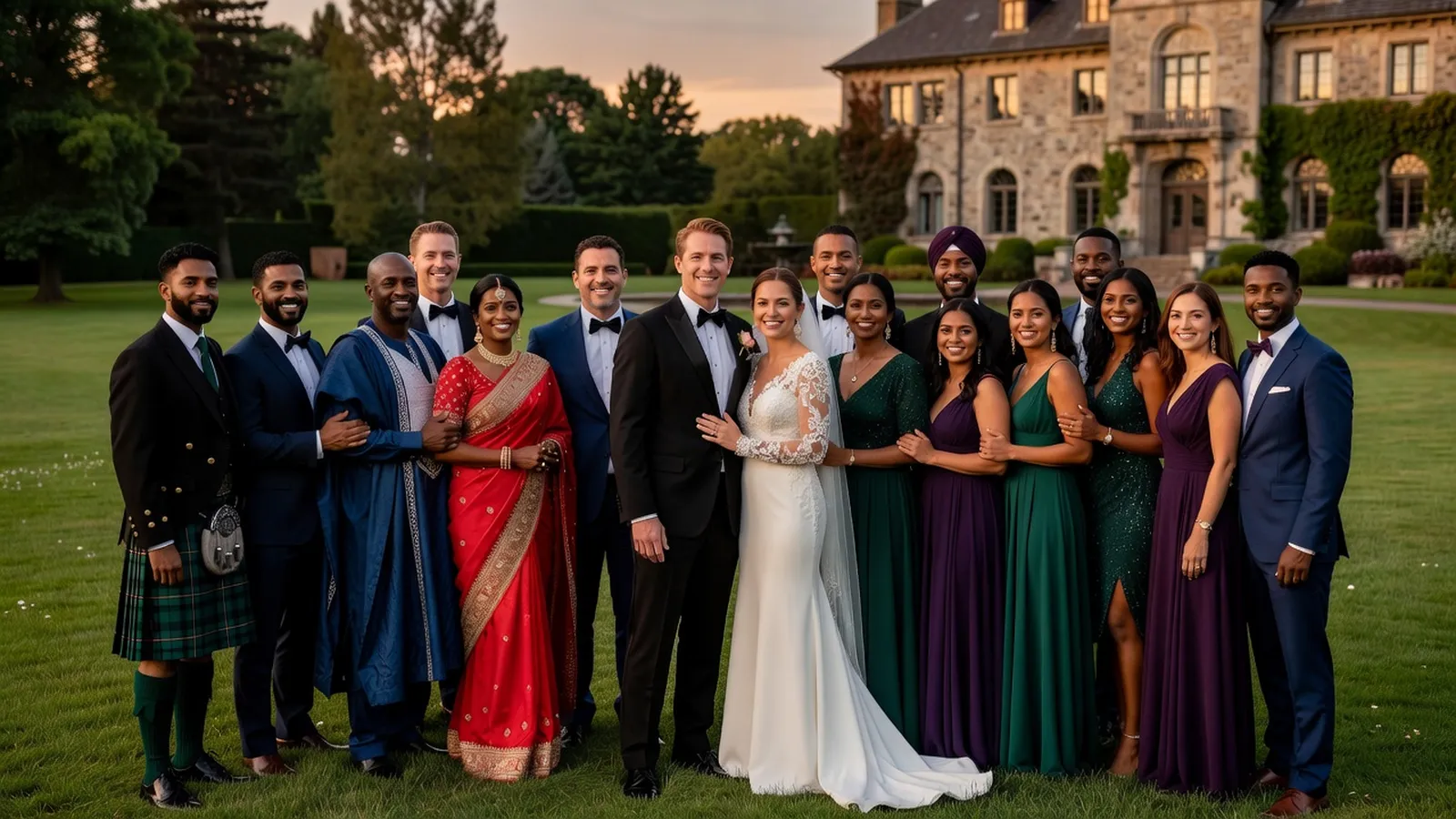
I start by asking a practical question: who in the room will be lost without help? Not every guest needs full translation. Often it is two or three grandparents, or one side of the family, who would otherwise sit through the vows without following them. Once the couple names those people, the solutions become smaller and more human.
The simplest tools work best. A printed programme in two languages, a short welcome line in each language from the host or officiant, and a table plan that seats people who can help each other. For longer speeches, I ask speakers to pause at natural points so someone nearby can quietly pass along the meaning. It is gentler than interrupting the room.
Should the ceremony itself be bilingual or multilingual?
That is a decision for the couple and the officiant together. Some couples keep the legal wording in one language and add a heartfelt section in another. I do not want to overstate what is permitted. If a couple wants the ceremony itself conducted in a particular language, I ask them to confirm with the officiant first and, where there is any doubt, with the official sources. Whatever is decided, I make sure the officiant has the final order of events in advance, with names and pronunciations written out phonetically.
I also look after small things: name cards with correct spelling and diacritics, a seating plan that does not isolate people, and a quiet corner for guests who need a break from a language they are still learning. Language is as much about belonging as meaning.
Documents that travel home
What happens when the guests, or the couple, need paperwork recognized abroad?
This is the topic I tell couples to treat early and with caution, because I am a planner, not a lawyer. What I can say is that couples sometimes assume a marriage celebrated in Ontario will automatically be understood elsewhere. Our editorial team points to Global Affairs Canada, which explains that Canadian public documents meant for use in another country may need an apostille, and that whether the marriage is recognized depends on the destination country.
So I ask couples with ties abroad one clear question: where will you need this marriage to be recognized? If the answer is another country, they should find out early what that country requires, using the official authentication guidance and the relevant authority there. I never promise how another country will treat a document.
Do you handle that part for couples?
No, and I think any planner who claims to is overreaching. I keep a short list of documents the couple has asked about and a note of who they are asking. My job is to make sure the question is asked early enough that the answer does not collide with the wedding date. For questions about a specific document or country, the couple should speak to the authority responsible or a legal adviser.
Logistics: arrivals, venue and the plan B
How do you plan the weekend itself when many guests are arriving from far away?
I treat it like hosting people in your own home. International guests may arrive tired, with jet lag, unsure of local transit, and unaccustomed to the weather. A short welcome message with clear arrival details, a map, and a named person to contact makes a real difference.
I schedule the key moments, such as the ceremony and the main meal, so that guests have a chance to rest. I also keep an eye on the surrounding days. A relaxed gathering the evening before gives arriving guests a place to meet each other, and it moves some of the emotion out of the wedding day itself. For ideas on how Toronto's evening neighbourhoods work for these kinds of gatherings, our guide to Toronto after dark is a useful companion.
What about the venue and the city's event rules?
It depends on whether the reception happens in a turnkey room or somewhere that needs more arranging. For a turnkey venue, many practical questions are already handled. For anything else, our editorial team points to the City of Toronto's guidance for planning events, which covers noise, insurance and permits. I tell couples to read it early, because those items take time.
If you are still comparing rooms, our checklist on renting a private event space in Ontario goes through what to verify before signing. And if you want a different perspective on running a gathering from the planning side, the interview with an event planner on organizing a private party in Toronto covers overlapping ground.
What is your single best piece of advice for these weddings?
Build the plan so the ceremony can happen even if a few guests cannot travel. Everything flows from that. When the legal ceremony, the officiant, the witnesses and the core group are secure, the rest is celebration, and celebration is more flexible than people fear.
I would add one more thing: keep communication honest and kind. Guests from abroad are making an effort. Tell them what is certain, what is not, and what you will do if plans change. People forgive a great deal when they feel informed. If you want a wider view of marrying in this country, the pillar page on weddings and celebrations in Canada is the best place to continue.
Frequently asked questions
Do guests from abroad always need a visa to attend a wedding in Ontario?
Not always. According to IRCC, guests need either a visitor visa or an eTA depending on their nationality. The IRCC visitor help centre explains which applies, and approval is never guaranteed.
Does an invitation letter guarantee a visa?
No. IRCC may ask for an invitation letter, but the letter does not guarantee that a visa will be issued. It is one document among others in the guest's own application.
Do Ontario's marriage rules change when guests come from abroad?
No. The Government of Ontario's requirements, including a licence, an authorized officiant, two witnesses and a ceremony within 3 months of the licence, apply to every wedding held in Ontario.
Will an Ontario marriage be recognized in my guests' home country?
That depends on the destination country. Global Affairs Canada notes that Canadian public documents meant for use abroad may need an apostille, and recognition rests with the country concerned.
Where can I find city rules if the reception is outside a turnkey venue?
The City of Toronto publishes guidance for planning events, covering matters such as noise, insurance and permits. It is a useful starting point for a reception held outside a ready-to-go venue.
General information only. It does not replace advice from a lawyer or legal adviser; rules change, so check with the organization cited.
The King West Journal editorial team
Frequently asked questions
Do guests from abroad always need a visa to attend a wedding in Ontario?
Not always. According to IRCC, guests need either a visitor visa or an eTA depending on their nationality. The IRCC visitor help centre explains which applies, and approval is never guaranteed.
Does an invitation letter guarantee a visa?
No. IRCC may ask for an invitation letter, but the letter does not guarantee that a visa will be issued. It is one document among others in the guest's own application.
Do Ontario's marriage rules change when guests come from abroad?
No. The Government of Ontario's requirements, including a licence, an authorized officiant, two witnesses and a ceremony within 3 months of the licence, apply to every wedding held in Ontario.
Will an Ontario marriage be recognized in my guests' home country?
That depends on the destination country. Global Affairs Canada notes that Canadian public documents meant for use abroad may need an apostille, and recognition rests with the country concerned.
Where can I find city rules if the reception is outside a turnkey venue?
The City of Toronto publishes guidance for planning events, covering matters such as noise, insurance and permits. It is a useful starting point for a reception held outside a ready-to-go venue.
Sources
Verified on
- Immigration, Refugees and Citizenship Canada, Visit Canada: visa, eTA and the visitor help centre, IRCC, 2026.
- Government of Ontario, Getting married, Government of Ontario, 2026.
- Global Affairs Canada, Authentication of documents, Global Affairs Canada, 2026.
- City of Toronto, Guidance for planning events in Toronto, City of Toronto, 2026.
- Government of Ontario, Registered marriage officiants, Government of Ontario, 2026.